My previous blog post, "Why do women return so many online orders", sparked an unusually lively discussion, and I received emails about it too. It's rare for a newsletter to make anyone put pen to paper, so to speak, so a huge thank you.
Since there was so much discussion and so many ideas, the least we can do is try to learn something from it, which is why I wrote this follow-up. Here I'll go through some of your ideas that could help reduce returns.
On size charts
Papu has size charts that show a product's key measurements. Alongside the size charts, we also give the height of the model in the product photos and the size she's wearing. This is the so-called baseline that practically every online clothing store offers. If there are two models in the photos, both of their heights and sizes are given in the product description.
The two-model model
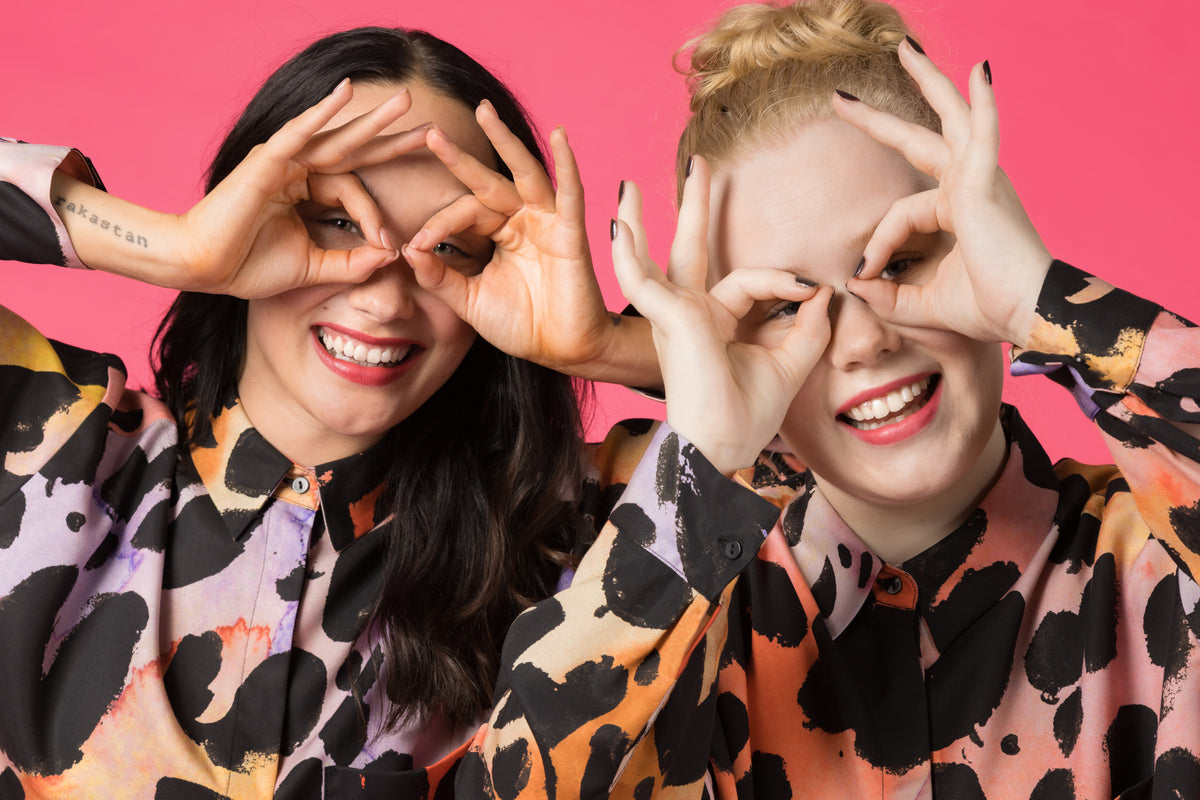
In our latest shoots we've used two models with different body types, but we haven't managed to photograph every product on both of them. Admittedly, we may have thought that if the same product comes in, say, three different prints or colours, it's enough for each model to appear in a photo with at least one of them. The problem, though, is that if a customer is interested in one product, she won't necessarily even click through to the sister product in a different colour, where she could see the same item on a different body type. That's something we need to take better into account in future.
Even though we use two models in our shoots, that isn't necessarily enough. Perhaps the most interesting discussion was about women's body types, and there are practically as many of them as there are customers – everyone is an individual. For example, two women's bodies may be otherwise alike, but one part of the body is significantly different. Naturally, this means the garment fits in a completely different way. A top's hem, for instance, sits at a different height depending on the width of the shoulders, the size of the bust or the length of the back. Yet the two women may be the same height and weight and usually wear the same size.
More models
One solution could be to use, say, three models from now on, but this starts to become a question of cost. On top of that, a shoot day has a limited number of hours and time is very literally money, so with three models we might not get any more photos done than with two. The products would then be spread even more thinly, so that not every product or style gets photographed with every model. Another problem is that even three models might still not add enough variety in body types.
The model's height
This discussion about body types also reminded me that models have a certain "flaw": they have "model proportions", meaning they're generally taller than the average woman. In our latest photos, the models are 170, 174 and 176 cm tall. According to a quick Google search, the average height of women in Finland is 163 cm. So we're talking about people who are significantly taller than average.
Not many women of average height end up as (fashion) models. One reason is that a garment usually looks more striking on a tall model. I've also tried using so-called amateurs in shoots earlier in my career and found that shoots simply go so much better with professional models. In the same way that I wouldn't get my neighbour to redo my plumbing but would want a professional, modelling takes professional skill.
Better body-type guidance for products
The discussion about body types did, however, give us the idea of adding more descriptions to products along the lines of "this product suits such-and-such a body type best". There's a small risk, though, that customers see it as black and white, and products go unsold because a customer doesn't feel she has that particular body type. Even so, I'm willing to give this a try too.
I've just processed a product return in which the customer had written that the top's hem rides up too high because of her bust. It struck me that this is exactly why customers' own experiences are so extremely valuable. I also read through the reviews we've received, and they very often deal specifically with body-type-related issues.
Making better use of customer feedback
We collect customer feedback automatically. Some time after a purchase, customers receive an email asking for feedback on the product they bought. I changed this email so that it describes better what a good review might include. Because good reviews are so valuable in reducing returns, I set up the automation so that every review earns a 10% discount code. Not every product sold leads to a review, though, so the real impact on sales will be smaller.
A few more words about money
A return rate of just over 18% adds up to a very significant sum of money. If annual sales are one million euros, returns have amounted to €219,000. In other words, sales were €1,219,000, of which €219,000 came back.
If returns could be reduced by even just 5 percentage points, that would mean €82,000 more in sales. That's the kind of sum that would turn many a clothing store from a cycle of losses into profit.
To finish, I'll leave you with a thought to mull over: how many Finnish clothing brands would have been saved from bankruptcy if their return rate could have been pushed down to, say, ten per cent? That's something for us entrepreneurs to work on.
Thank you for reading this far. I enjoy writing these, but it's even nicer that readers are interested. You're still very welcome to email me about this or anything else: tuomo.saarni@papudesign.com
- Tuomo, Papu's CEO