AI has been the talk of the town for a good few years now, and not without reason. The creative industries, which everyone assumed would be the last to be touched by AI, have in fact been among the first to feel its arrival. Naturally, these include the clothing industry, which is home to many different kinds of creative work. In this post we look at what kind of threat or opportunity AI represents for Papu and for every other clothing company.
Where we are now
Papu already uses AI, and I should say that right at the start. It would be mad not to, as it does things a human simply cannot do in practice. Let's look at some examples.
Data processing
We have a vast amount of data in our online shop. For example, our Finnish-language web shop alone has over 121,000 orders and more than 55,000 customers. If we want to pull some kind of report out of all that, AI does what we could never manage ourselves. What's more, it does it from simple instructions written in plain Finnish, without anyone needing to know their way around Excel or how to code. You can even ask AI which parts of the data are worth looking at and what actions they point to.
That said, AI isn't always the answer to everything. One of its suggestions was that we should start selling paper bags, since they had been Papu's best-selling product back when Papu still had bricks-and-mortar shops.
Proofreading
I've used AI to proofread these posts I write, but I always ask it only to point out typos, never to rewrite the text. AI-generated text is often easy to spot, as you'll notice on plenty of social media channels these days. AI also has a particular fondness for lists and dashes, which I don't think suit these blog posts at all.
Development and bug fixing
We've also used AI a great deal to develop the online shop. It has helped us solve problems, fix bugs and add features. In the past, every little thing meant buying some sort of paid add-on, but these days AI simply codes the feature for us. For example, when we wanted the summer sale product images to carry a label showing that the item was on sale, along with the discount percentage, with everything getting bigger the bigger the discount, we did it by having AI modify an existing app.
Image edits
Fourthly, we've used AI a few times to edit product images. For example, the model in the main image of this puff wrap dress has had trousers added, because without them the dress didn't look the way we'd imagined it being worn. Now that images like this will have to be labelled in future if they've been edited with AI, we'll be taking care of that labelling with a little help from AI.
Image editing software uses AI these days, and it will become increasingly hard to tell which edits have been made with AI. For instance, every photo taken with a model has to be post-processed. Post-processing involves things like cropping, colour balancing, cutting out (removing the background) and resizing images to a suitable size. The editing software uses AI for all of these without the user even being aware of it. The software just seems really easy to use and does a lot of things automatically. In the past, the same tasks required far more skill from the user.
Earlier in Papu's history, the photographer traditionally did the image editing, but at some point this laborious stage was outsourced to India. Today AI has made post-processing so much easier that it's once again done by either the photographer or the photo studio.
Looking ahead
We've been thinking about how AI could be used in future in a way that is not only ecological but also fair to customers and in line with what they expect. In other words, we certainly don't want Papu to become a clothing maker where people have been replaced by AI. On the contrary, our aim is to make ourselves more efficient by using AI as a tool where it makes sense.
Our clothes will still be made by human hands
At Papu, people still design the prints and the garments, and of course that isn't going to change. AI can lend a hand here, though. In print and garment design, for example, AI can show us what a print will look like as a finished garment on a person, without first spending a great deal of resources on making sample fabric, sewing a prototype, shipping it all, fitting it and finally sending it back to the factory.
We can now try out lots of different cuts and prints at the design stage easily, cheaply and quickly, and only then move on to making an actual physical sample with the best prints and cuts. This saves a huge amount of resources and gives us a large number of options to whittle down. At its peak, Papu made over a thousand samples of different garments a year. Now that number can be cut to a fraction, which is an enormous saving in resources.
A faster route to market
Using AI in this way also means we can use AI images for product pre-orders. In other words, we can take an existing garment, for example, and combine it with a new print using AI before the actual product even physically exists. Going forward, of course, every garment will still go through a prototype stage, meaning a sample is made and the designer approves it, either with or without changes.
We've sometimes been able to use that sample in photo shoots if it hasn't changed much by the time it goes into production. But if the product does change (and it often does), we have to wait for the first pieces off the production line before we can shoot it. Only after the shoot, once the images are finished, can the product go on sale.
With AI, we can now create images of a garment while it's still in production and open pre-orders. If pre-orders point to strong sales, we can still adjust production quantities, which also makes us more efficient.
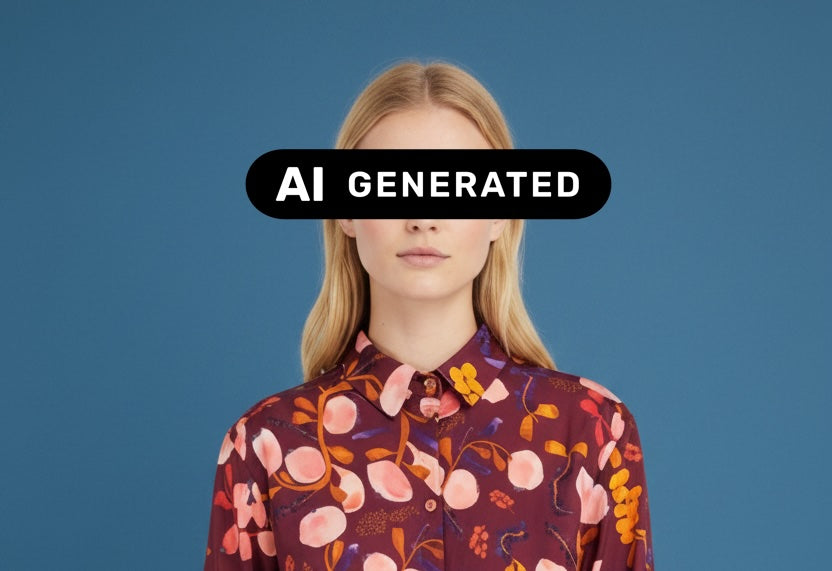
We'll keep using real models and professional photographers. Our regular product images are shot by professional photographers on real people, so that we have pictures of the products being worn by real people. For pre-orders, however, AI images may be used, and they will be clearly labelled.
The downsides of AI
AI also uses resources. It consumes huge amounts of electricity during training. Newer, more efficient algorithms have improved the situation, but the demand for electricity is still significant. Data centres also produce vast amounts of heat, but in Finland we know how to put the heat these systems generate to good use, for example in district heating. Nor is water wasted in Finland, as the systems run in a closed loop. AI needs an enormous amount of computing power, which means an enormous number of processors, and making them often uses rare earth metals. So although AI saves many kinds of resources and makes things more efficient, it doesn't come for free and the coin has another side.
Pre-orders open this week
We plan to test AI-generated images for the first time in the autumn pre-orders opening this week. The images will be labelled as AI-generated, and the product images will later be replaced with real photos. We also intend to be upfront in the product descriptions about the challenges AI brings, namely that an AI-generated image may differ from the real, final product.
-Tuomo, CEO of Papu